
Marquette County Arrest Records and Court Charges
A Marquette County arrest record begins with a single event. Police take a person into custody. The record names the arresting agency, the date, and the booking that follows. The county sheriff runs the jail where booking happens. Before a person is arraigned, the jail shares very little. Staff may confirm only that someone is lodged and state the bond amount. The full booking detail and the jail listing sit on the custody side of the system, and that side is covered on the Marquette County inmate records page.
The court charge record is a different thing. An arrest does not settle the charges. That job belongs to the county prosecutor. The prosecutor reviews the police report and files formal charges with the court. Jenna Nelson serves as Marquette County Prosecutor, and the office works out of the Courthouse Annex on West Baraga Avenue. Once charges are filed, they enter the court file and move through hearings. Court charges after arrest can shift as a case develops. The complete case file, with pleas and sentencing, sits in the Marquette County criminal court records.
The Marquette County Sheriff runs a mobile app that exposes custody tools the county website does not. The Apple App Store listing shows the app, which includes a jail inmate lookup after arraignment.
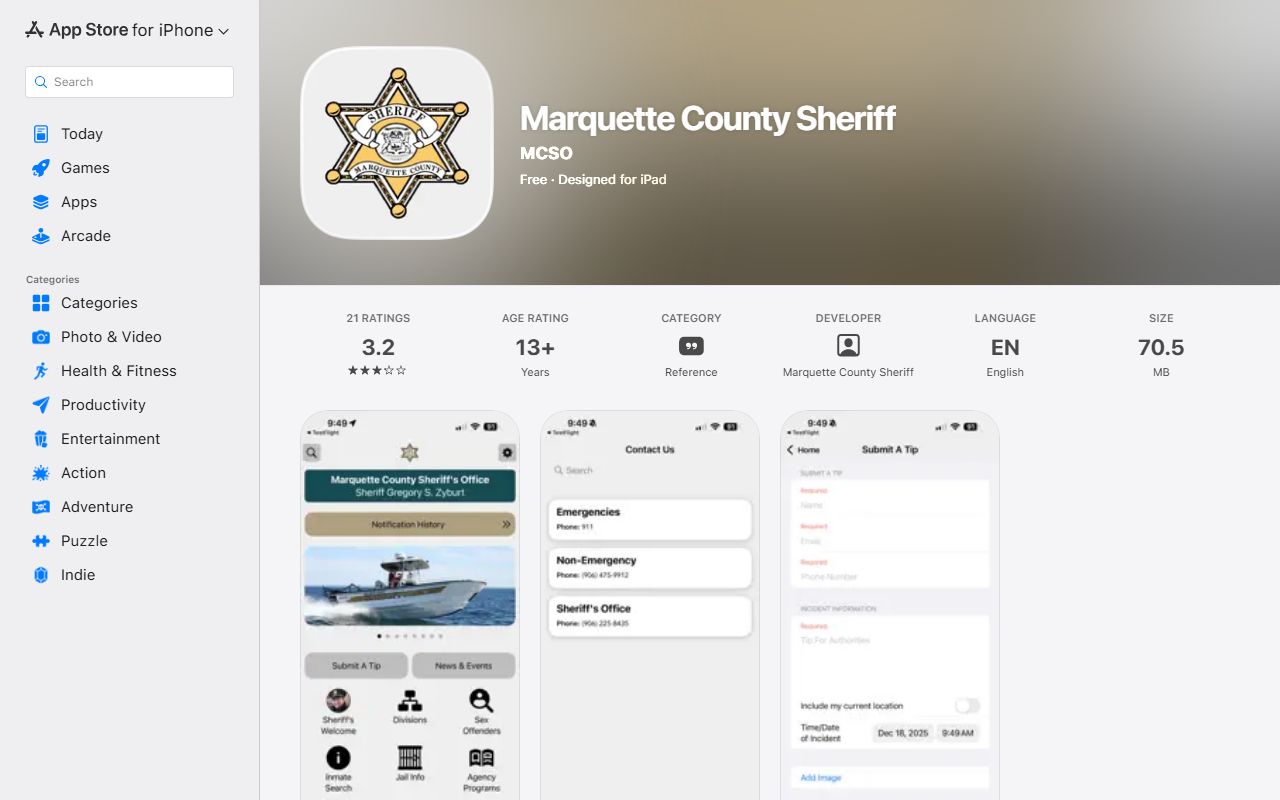
That app reflects the booking side of an arrest. It is separate from the charge record the court keeps once the prosecutor files.
How Charges Get Filed in Marquette County
The charge record starts when a charging document is filed. In Michigan, the first stages run through the 96th District Court. A complaint and warrant open the matter. The person is arraigned, bond is set, and a probable cause stage tests a felony before it moves up. The prosecutor decides which charges to bring and under which statute. Questions about a filed charge go to the Prosecutor's Office at (906) 225-8310. Three charging documents are used, and each fits a different type of case.
| Complaint | Information | Indictment | |
|---|---|---|---|
| Filed By | Officer or prosecutor | Prosecutor | Grand jury |
| Common For | Misdemeanors and the first felony stage | Felonies after bindover | Serious felonies, rare in Michigan |
| Where Filed | 96th District Court | 25th Circuit Court | Circuit Court |
| Role | Sworn accusation that opens the case | Formal felony charge after a preliminary exam | Charge returned by citizens on the grand jury |
Most Marquette County felonies follow the complaint-then-information path. Police or the prosecutor file a complaint. The District Court holds a preliminary exam. If the judge finds probable cause, the case is bound over to the 25th Circuit Court, where the prosecutor files the information. Grand jury indictments are uncommon in Michigan and rarely appear in local records. A charge does not require an arrest first. The prosecutor can review a complaint and file charges that lead to a warrant, so a court charge record can open before anyone is taken into custody.
Marquette County Charge Codes and Severity
Every charge ties back to a Michigan statute. The charge record lists the offense description and the code, most often a Michigan Compiled Laws (MCL) citation, sometimes a local ordinance. The code fixes the severity level. Severity controls which court hears the case, the possible penalty, and how the charge shows up in a search. One arrest can produce several separate charges at once, and they do not all carry the same weight.
- Felony: the most serious level, punishable by more than one year and heard in the 25th Circuit Court after bindover.
- High-court misdemeanor: a serious offense that Michigan routes through circuit court like a felony.
- Misdemeanor: handled in the 96th District Court, with jail terms up to one year depending on the statute.
- Civil infraction: a non-criminal violation, common for traffic, resolved with fines and points rather than jail.
Because a single incident can yield a felony count plus lesser counts, a charge record may look longer than the arrest that produced it. Reading each code and level separately keeps the picture accurate.
Charge Status in Marquette County Records
Charges are not fixed once filed. They change as the case moves. A prosecutor can amend a count, reduce it, add one, or drop it. A judge can dismiss a charge. The status field on a court record tracks where each count stands right now. The terms below appear often in Marquette County case files.
| Status | What It Means |
|---|---|
| Pending | The charge is filed and active, waiting for a hearing, plea, or trial. |
| Amended / Reduced | The prosecutor changed the count, often to a lesser offense, as part of a plea or new facts. |
| Dismissed | The court ended the charge; dismissal with prejudice blocks refiling, without prejudice does not. |
| Nolle Prosequi | The prosecutor formally declined to pursue the charge, dropping it from the case. |
| Bound Over | A District Court judge found probable cause and sent the felony charge up to Circuit Court. |
Reading status matters more than reading the first charge listed. A count filed as a felony may end as a reduced misdemeanor or a dismissal. Note: a dropped or dismissed charge can stay visible in the public case index even after the charge itself no longer stands.
How to Find Marquette County Arrest Records
Official case access runs through MiCOURT, the state court search. Charges and charge status show up in the case index for each court level. Use the 25th Circuit Court search for felonies and the 96th District Court search for misdemeanors and traffic. Booking and custody detail are not in these portals; that side lives in the jail lookup on the sheriff app and by phone.
- Open the correct MiCOURT link for the court level: Circuit for felonies, District for misdemeanors.
- Search by the defendant name or, if known, the case number.
- Open the case and read the full charge list, not just the top count.
- Check each charge for its statute code, severity level, and current status.
The Google Play listing for the Marquette County Sheriff app shows the same jail inmate lookup on Android devices.
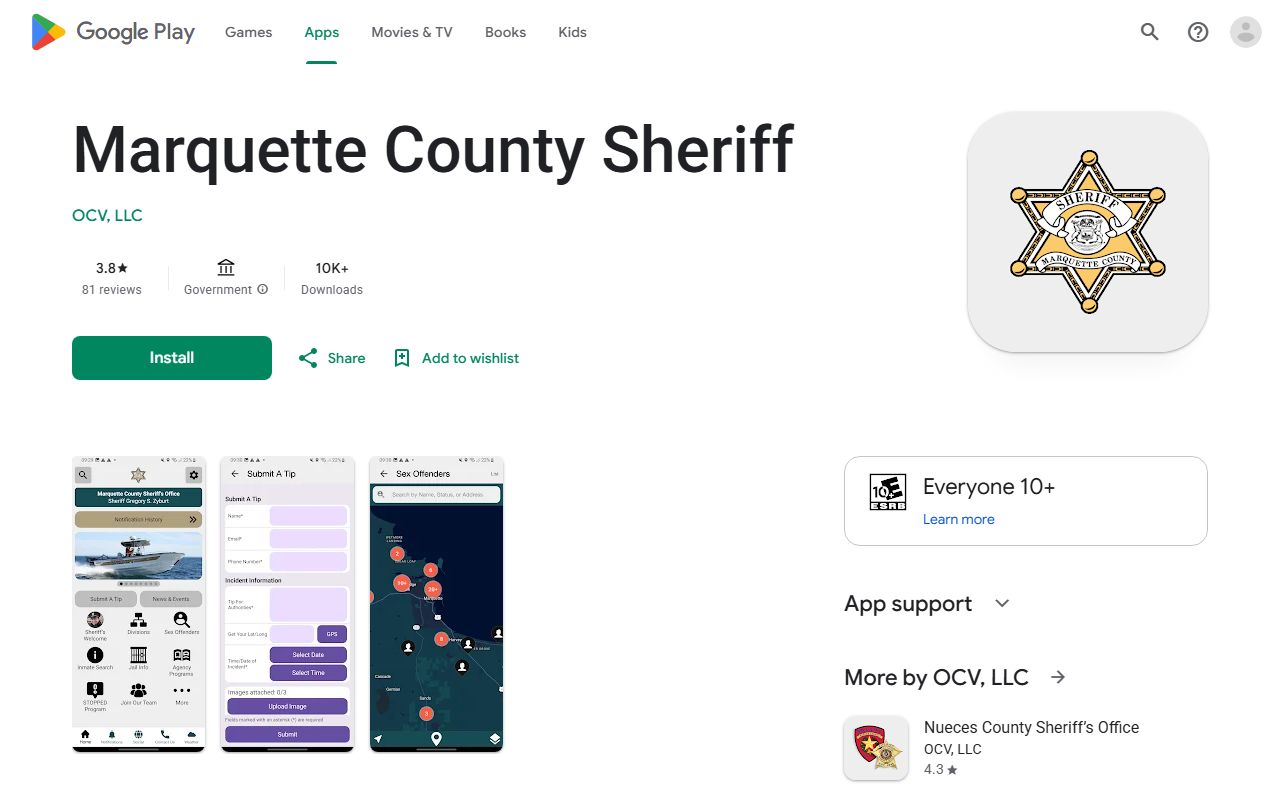
The app answers the custody question after arraignment. MiCOURT answers the charge question. Together they cover the arrest-to-charge path.
Charges vs. Convictions in Marquette County
Being charged is not the same as being convicted. A charge is an accusation. A conviction is a result. The gap between them is the whole point of the court process, and reading a record without that gap in mind leads to wrong conclusions.
| Charge | Conviction | |
|---|---|---|
| Stage | Accusation at the start of a case | Verdict or plea at the end |
| Burden of Proof | Probable cause | Guilt beyond a reasonable doubt |
| Meaning | A person is accused, not proven guilty | The court found or accepted guilt |
| Public Record | Yes, in the case index | Yes, and it may reach a criminal history |
A record that shows filed charges may end in acquittal, dismissal, or a reduced plea. The charge line and the disposition line tell two different stories. Both belong to a full reading of the case.
Statewide Charge and Criminal History Lookups
A single Marquette County case shows one file. A person's full history spans courts and years. For a statewide name-based conviction check, Michigan uses the State Police ICHAT tool, the Internet Criminal History Access Tool, which returns Michigan public conviction data for a fee. For people under state supervision, the Michigan Department of Corrections runs OTIS.
The MDOC OTIS search covers prisoners, parolees, probationers, and offenders discharged within the last three years.
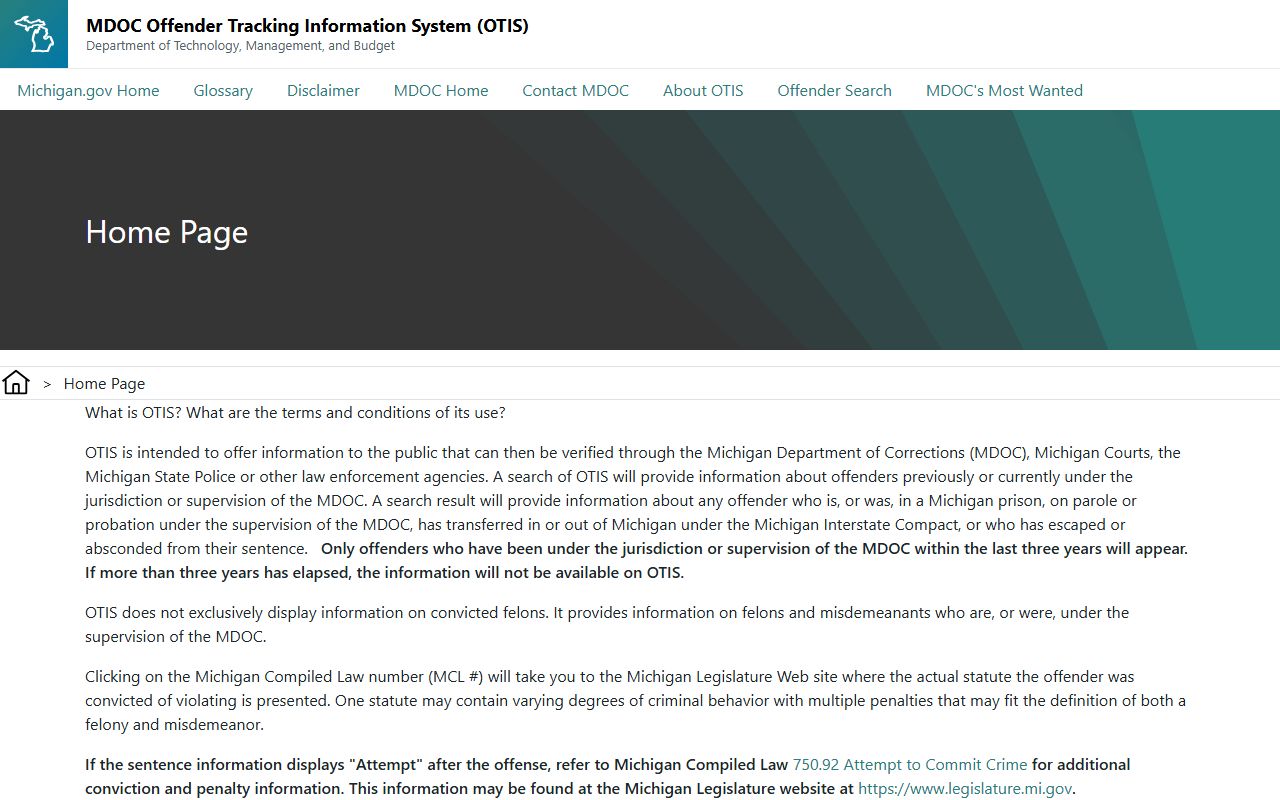
OTIS is not a county jail roster and not a full criminal history. It only reflects current or recent MDOC jurisdiction, as the corrections agency explains on its own page.
The MDOC OTIS information page spells out what the tool includes and what it leaves out.
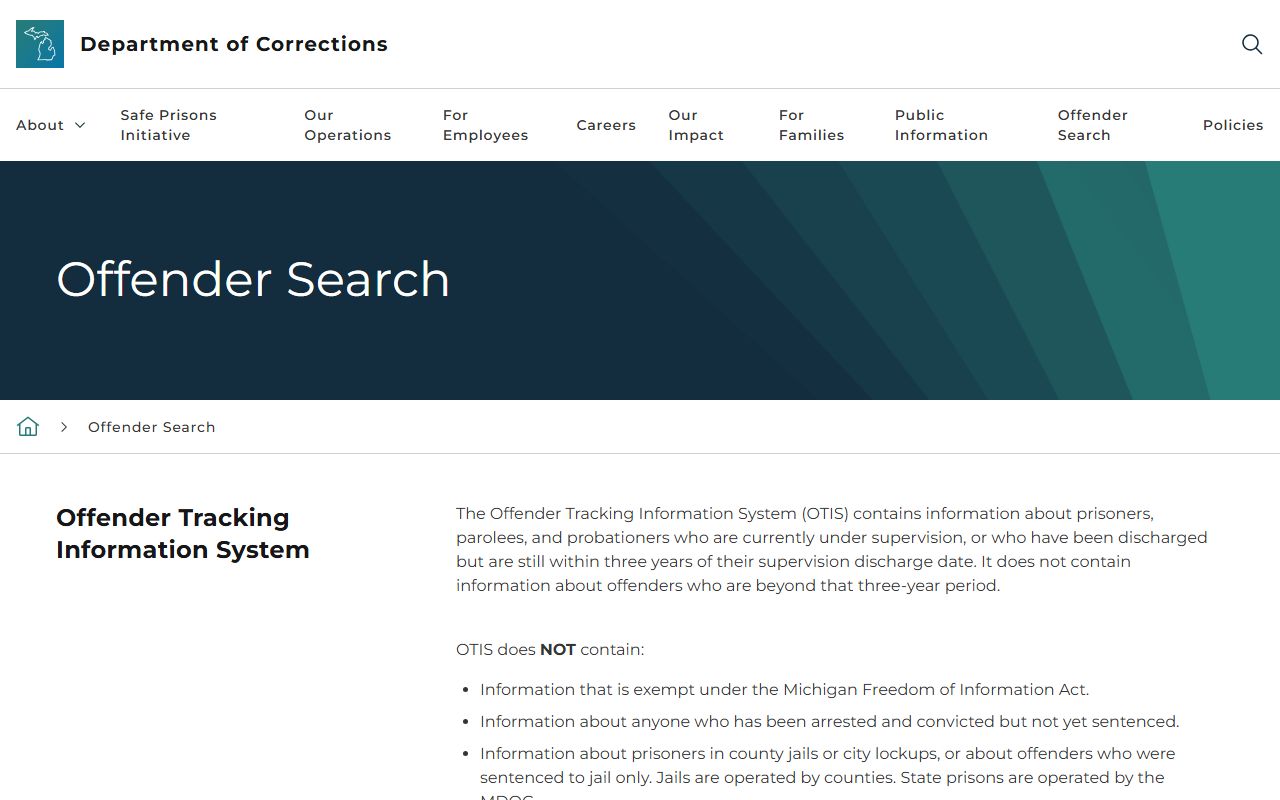
Federal charges follow a separate track. A person held on a federal case does not appear in state or county tools.
The Federal Bureau of Prisons inmate locator handles searches for people in federal custody.
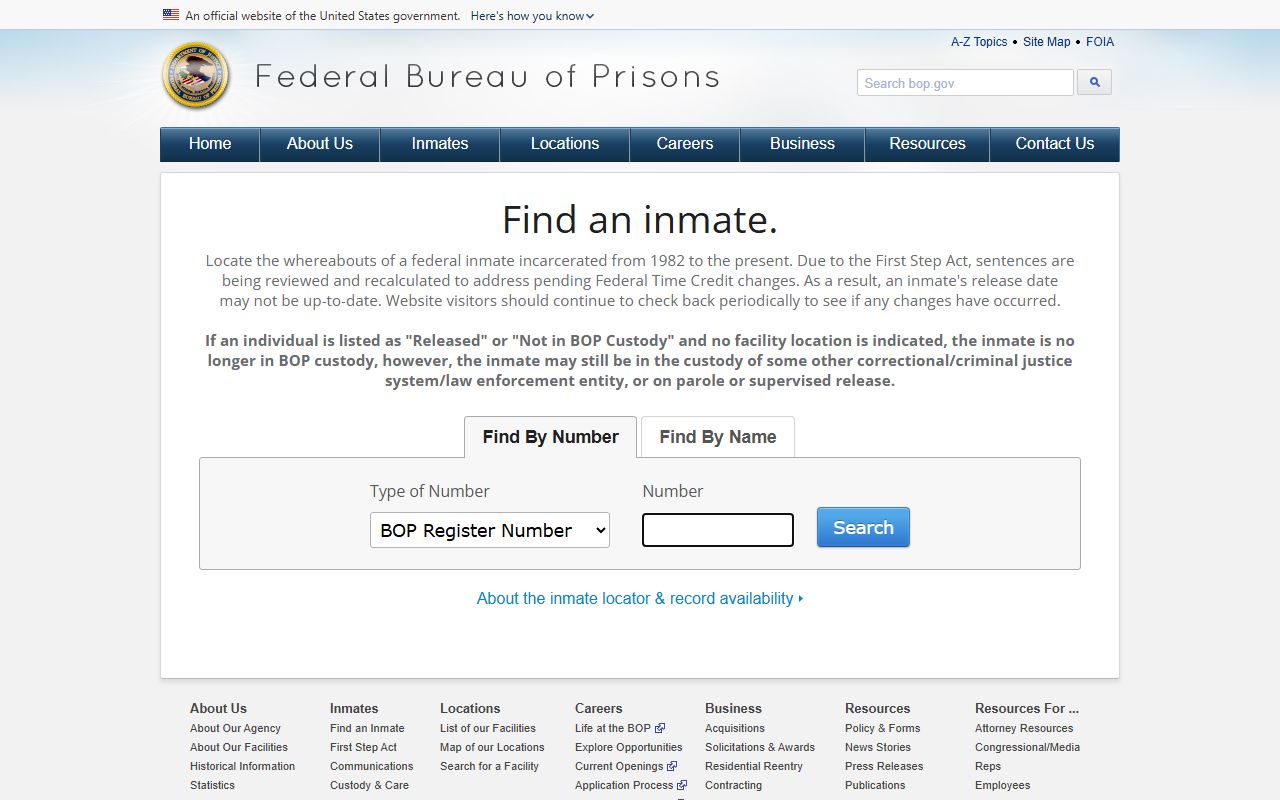
Between ICHAT, OTIS, and the federal locator, most charge and custody questions map to one clear source. Note: OTIS lists sentenced state offenders only, so an active local charge before sentencing will not appear there.
Important: Marquette County Court Records is not a consumer reporting agency, and its results cannot be used for employment, credit, tenant, or other FCRA-regulated screening.
Public Access to Marquette County Charge Records
Court charge records are public by default, with limits. Michigan Court Rules govern access to case files, clerk duties, and the register of actions that lists every charge and event. Full document images may require a clerk request or in-person review, even when the index is online. The right to inspect and copy public records also appears in the state Freedom of Information Act at MCL 15.233, which mainly reaches sheriff and county administrative records rather than the court case file.
The Michigan Attorney General FOIA overview explains how a public-records request works and what a public body may charge.
For a court case file, the clerk path usually beats a FOIA letter. County Clerk handles circuit records. The District Court clerk handles district charges. Each holds the documents behind the online index. A criminal or civil record check through the County Clerk carries a small fee and confirms what the file holds.
Restricted Charge Records in Marquette County
Not every charge is open to the public. Juvenile charges are restricted under MCL 712A.28, so delinquency records generally stay closed to a routine search. Some records are removed later. Michigan lets eligible adults set aside convictions under MCL 780.621, and the Clean Slate changes plus automatic set-asides have widened who qualifies.
A set-aside makes a conviction nonpublic for most purposes, though law enforcement and courts keep access. People apply with the state court form, the SCAO MC 227 application, filed in the court where the conviction occurred. The Michigan State Police set-aside page explains what happens to a conviction once it is set aside.
Ongoing investigations, sealed material, and protected personal identifiers are also withheld. Note: a set-aside removes a conviction from most public view, but a traffic conviction still stays on the Secretary of State driving record under state law.