
Criminal Court Records in Marquette County
A criminal court record is the case file a court clerk opens once charges are filed. It is not the arrest report and not the jail booking sheet. It is the running legal record of one prosecution. Every filing, hearing, order, plea, and sentence is logged in it. The file grows as the case moves. When the case ends, the record stays public unless a court seals or sets it aside.
The record is built and held by the trial court that handles the case. In Marquette County that means the 96th District Court, the 25th Judicial Circuit Court, or both, depending on the charge. The County Clerk, Linda Talsma, is also the clerk of the circuit court, so circuit criminal files run through that office. The District Court keeps its own case files. A closer look at the charges themselves lives in the Marquette County arrest records and court charges, while the full range of civil and family files sits with the broader Marquette County court records.
Most records begin with a complaint. The prosecutor reviews the police work and files a charge. From that filing forward, the court tracks the matter as an open case.
Which Marquette County Courts Keep Criminal Records
Michigan splits criminal work between two trial courts. The 96th District Court handles the early stages of every case and the full life of a misdemeanor. It takes complaints, sets bond at arraignment, holds probable cause conferences, and runs preliminary examinations on felonies. Traffic misdemeanors, ordinance violations, and bench warrants also route through the District Court.
Felonies do not stay in District Court. After a preliminary examination or a waiver, the felony is bound over to the 25th Judicial Circuit Court. The Circuit Court is the trial court with the broadest powers in the county. It takes the felony from bindover through the information, plea or trial, verdict, and sentencing. Appeals from District Court criminal cases also land in Circuit Court.
Because of that split, one serious case can leave a record trail in both courts. The District Court file shows the charge, the bond, and the exam. The Circuit Court file shows the plea, the trial, and the sentence. Reading both gives the complete picture.
How a Marquette County Criminal Case Moves
A criminal case moves through set stages, and each stage leaves a mark in the record. Knowing the order helps a reader place any single docket entry in context. The felony path is the longest because it crosses two courts.
Case flow: Charges Filed › Arraignment › Probable Cause Conference › Preliminary Examination › Bindover › Plea or Trial › Disposition › Sentencing
- Charges filed. The prosecutor files a complaint that names the defendant, the offense, and the statute cited.
- Arraignment. The District Court reads the charge, sets or reviews bond, and enters a first plea.
- Probable cause conference. A felony pre-exam stage where the parties discuss the case, bond, and possible resolution.
- Preliminary examination. A District Court judge decides whether enough proof exists to send a felony forward.
- Bindover. The felony transfers from the 96th District Court to the 25th Circuit Court.
- Plea or trial. The defendant pleads, or a judge or jury weighs the proof at trial.
- Disposition. The case ends by plea, verdict, dismissal, or acquittal, and the outcome is recorded.
- Sentencing. After a conviction, the court imposes jail, prison, probation, fines, or restitution.
A misdemeanor skips the exam and bindover steps and finishes inside the District Court. A felony runs the full ladder. Note: many Marquette County proceedings use remote options, so a docket hearing link does not always mean an in-person appearance is required.
What a Marquette County Criminal Court Record Shows
A criminal case file is a stack of connected fields. The register of actions is the spine, listing every event by date. Around it sit the party names, the charges, the financial terms, and the outcome. The table below breaks down the fields a reader meets most often when pulling a Marquette County criminal case file.
| Field | What It Shows |
|---|---|
| Case Number | The court index number, usually built from the year, case type, and court sequence. |
| Court | The 96th District Court, the 25th Circuit Court, or both when a felony is bound over. |
| Defendant | The person charged, styled as People v. defendant in the caption. |
| Charges | The offense description, the statute or citation, and the level or class of the charge. |
| Attorneys | The assigned prosecutor and defense counsel, whether retained, court-appointed, or public defender. |
| Bond | The amount and type of release, such as cash, surety, or personal recognizance. |
| Register of Actions | The dated list of filings, motions, hearings, orders, and warrants. |
| Plea | The defendant's formal answer to the charge. |
| Disposition | The outcome of each charge, such as guilty, dismissed, or acquitted. |
| Sentence | The punishment imposed, including jail, prison, probation, fines, costs, or restitution. |
Some fields are trimmed for privacy. Social Security numbers, financial account data, minor names, and protected personal identifying information are redacted under Michigan court rules even when the rest of the file is public.
How to Search Marquette County Criminal Court Records
Official online access runs through MiCOURT, the state court case-search system. The county court directory links three court-specific endpoints: Circuit Court C25, District Court D96, and Probate Court P52. For a criminal matter, pick the court level first, then run a party or case-number search. The steps below follow that path.
- Start on the Marquette County court directory or online services page, not a third-party search site.
- Choose the court. Use the 96th District Court D96 search for misdemeanors and early felony stages, and the 25th Circuit Court C25 search for bound-over felonies.
- Search by defendant name or case number, using exact spelling where possible.
- Narrow by case type and date range where the portal exposes those filters.
- Open the case to read the register of actions and the disposition entry.
- Request a certified copy or full document image from the clerk when the online index is not enough.
The visible search fields are consistent across the courts. The table lays out the MiCOURT public case-search inputs so a reader knows what each field expects.
| Field Label | Type | Required | Notes |
|---|---|---|---|
| Court | preset link / dropdown | Yes | Marquette C25 circuit, D96 district, P52 probate |
| Search by | tabs / radio | Yes | Name or case number are the core paths |
| Last Name / Business Name | text | Conditional | Used for party search; use exact spelling |
| First Name | text | Optional | Narrows individual searches |
| Case Number | text | Conditional | Full number if known; format varies by court |
| Date Range | date fields | Optional | Narrows large result sets |
| Case Type | dropdown / filter | Optional | Criminal, civil, traffic, family, probate |
MiCOURT returns a register of actions, not always a full document image. For a statewide criminal history that reaches beyond a single case, the Michigan State Police ICHAT service is the correct tool, and sentenced state prisoners appear in the MDOC OTIS offender search. Note: document images, older files, and sealed matters usually require a direct request to the District Court clerk or the County Clerk.
The Prosecutor and Public Defender in Marquette County
Charges do not appear on their own. The Marquette County Prosecutor's Office reviews police work and decides what to file. Prosecutor Jenna Nelson leads the office from the Courthouse Annex at 234 West Baraga Avenue, reachable at (906) 225-8310 or mqtpa@mqtco.org.
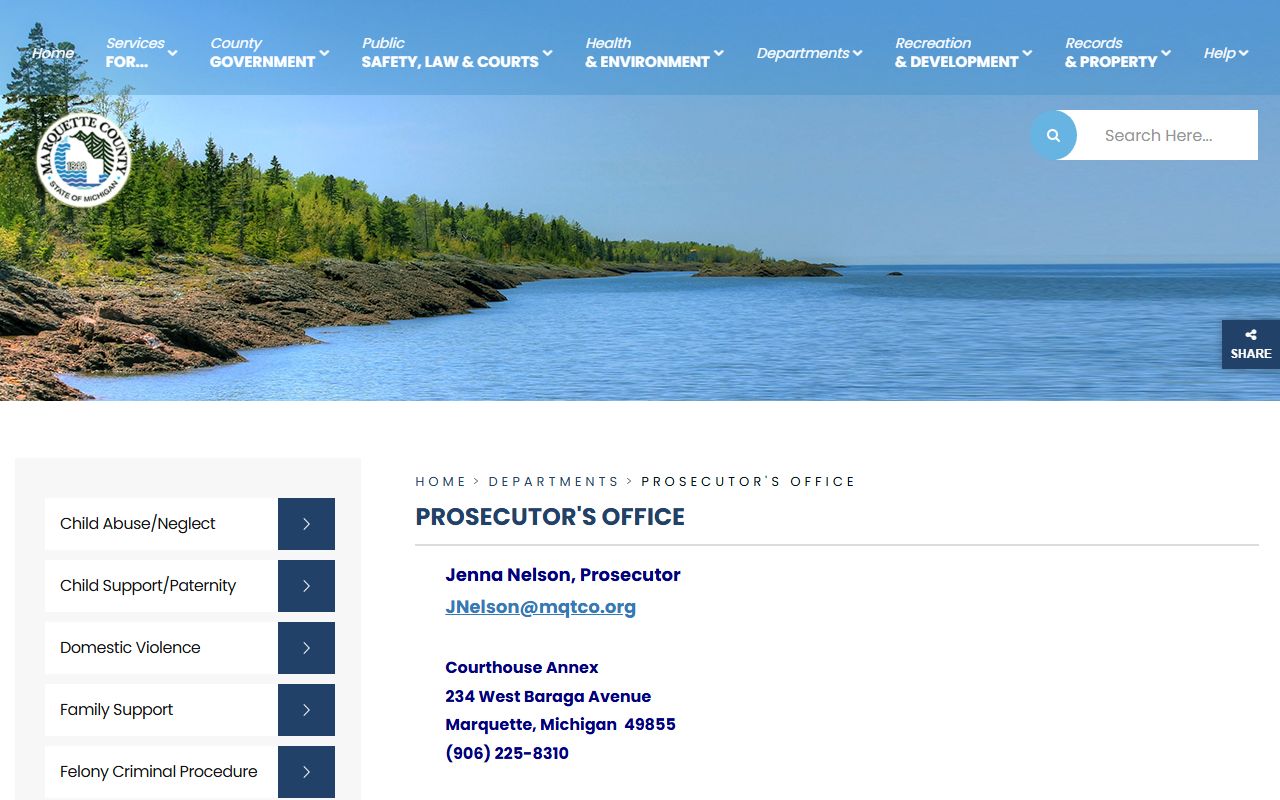
The office is the largest prosecutor's office north of Bay City. It handles roughly 1,200 to 1,500 misdemeanor cases and 800 to 1,000 felony cases each year, plus criminal appeals to the Michigan Court of Appeals and the Michigan Supreme Court. Its charging choice is what opens the criminal court record.
The staff behind those numbers is listed on the office staff biographies page, which names the chief prosecuting attorney, assistant prosecutors, a witness coordinator, and a victim advocate.
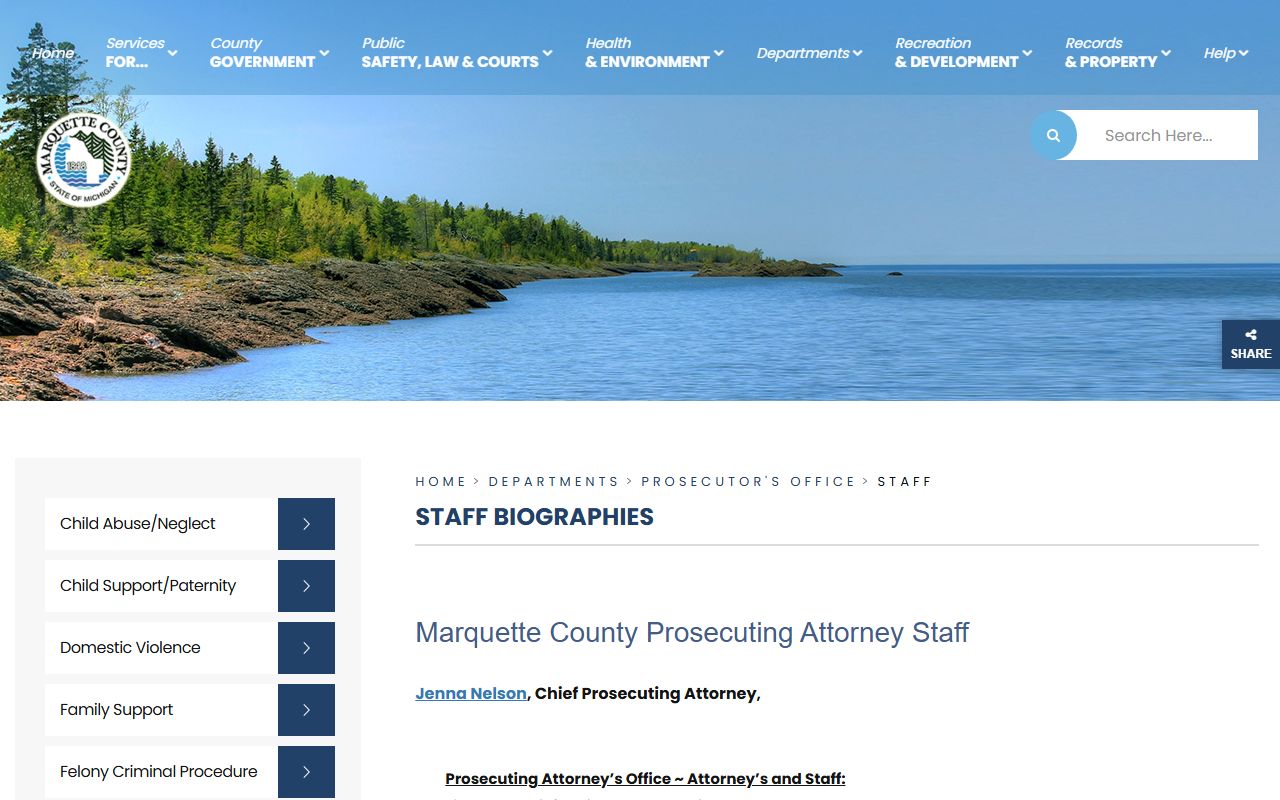
The attorney names show up in the case file as the People's counsel of record. On the other side, defendants who cannot afford a lawyer are represented by the Marquette County Public Defender, created in 2018 with a Michigan Indigent Defense Commission grant.
The Public Defender represents county residents in both District and Circuit Court on misdemeanors and felonies. The office sits at 228 West Washington Street, Suite 3, and answers at 906.226.4370 or MQTPubDef@mqtco.org. Both the prosecutor and the defense attorney of record appear in the criminal court file.
Charges vs. Convictions in Marquette County
A charge is not a conviction. Being charged means the prosecutor accused a person of a crime. A conviction means a court found the person guilty, by plea or by verdict. A criminal court record can show charges that were later dropped, dismissed, or ended in acquittal. Reading the disposition field is what tells the two apart.
| Charge | Conviction | |
|---|---|---|
| Stage | Accusation filed by the prosecutor | Verdict or plea entered by the court |
| Burden of Proof | Probable cause | Beyond a reasonable doubt |
| Can It Change | Amended, reduced, or dismissed | Final unless appealed or set aside |
| Public Record | Yes | Yes |
This gap matters for anyone reading a file. A long charge list at the top of a case may shrink to a single conviction, or to none, by the end. Always read the case to its disposition before drawing a conclusion.
Reading Dispositions and Sentences
The disposition is the outcome of a case or a single charge. The sentence is the punishment that follows a conviction. Both sit near the end of the register of actions. Michigan case files use a set of standard terms, and knowing them makes the record readable. The list below defines the ones that come up most.
- Disposition
- The result recorded for each charge, such as guilty, dismissed, or acquitted.
- Dismissed with prejudice
- The charge is dropped and cannot be refiled.
- Dismissed without prejudice
- The charge is dropped but may be refiled later.
- Sentence
- The jail, prison, probation, fine, or restitution ordered after a conviction.
- Probation
- Court supervision served in the community instead of, or after, custody.
- Restitution
- Money the court orders a defendant to pay a victim for loss.
A sentence entry often stacks several parts. It may list custody time, then probation, then costs and restitution in the same order. Read each line, because one conviction can carry more than one condition.
Public Access to Marquette County Criminal Court Records
Criminal case files are public in Michigan, subject to set exemptions. Court records are governed mainly by the Michigan Court Rules and the clerks' access procedures, not by ordinary open-records requests. The Freedom of Information Act still governs county administrative and sheriff records, and it frames the public's baseline right to inspect government files.
Key Statutes and Rules:
MCL 15.233 gives the public the right to inspect, copy, or receive copies of public records, subject to exemptions.
MCL 15.231 sets Michigan's public policy favoring full and complete information about public bodies.
MCR 8.119 governs court records, the duties of clerks, the register of actions, and public inspection of court files.
When a case is not posted online, the correct clerk fills the gap. The County Clerk handles circuit criminal documents, and the 96th District Court clerk handles district files at (906) 225-8235. Note: full document images and certified copies almost always require the clerk, even when the online index is fully public.
Sealed vs. Expunged Records
Michigan uses the term set aside for what many people call expungement. Setting a conviction aside makes it nonpublic for most purposes, though law enforcement and the courts keep access. Sealing is narrower and hides a file or entry from public view without erasing it. The set-aside statute, MCL 780.621, governs which adult convictions qualify.
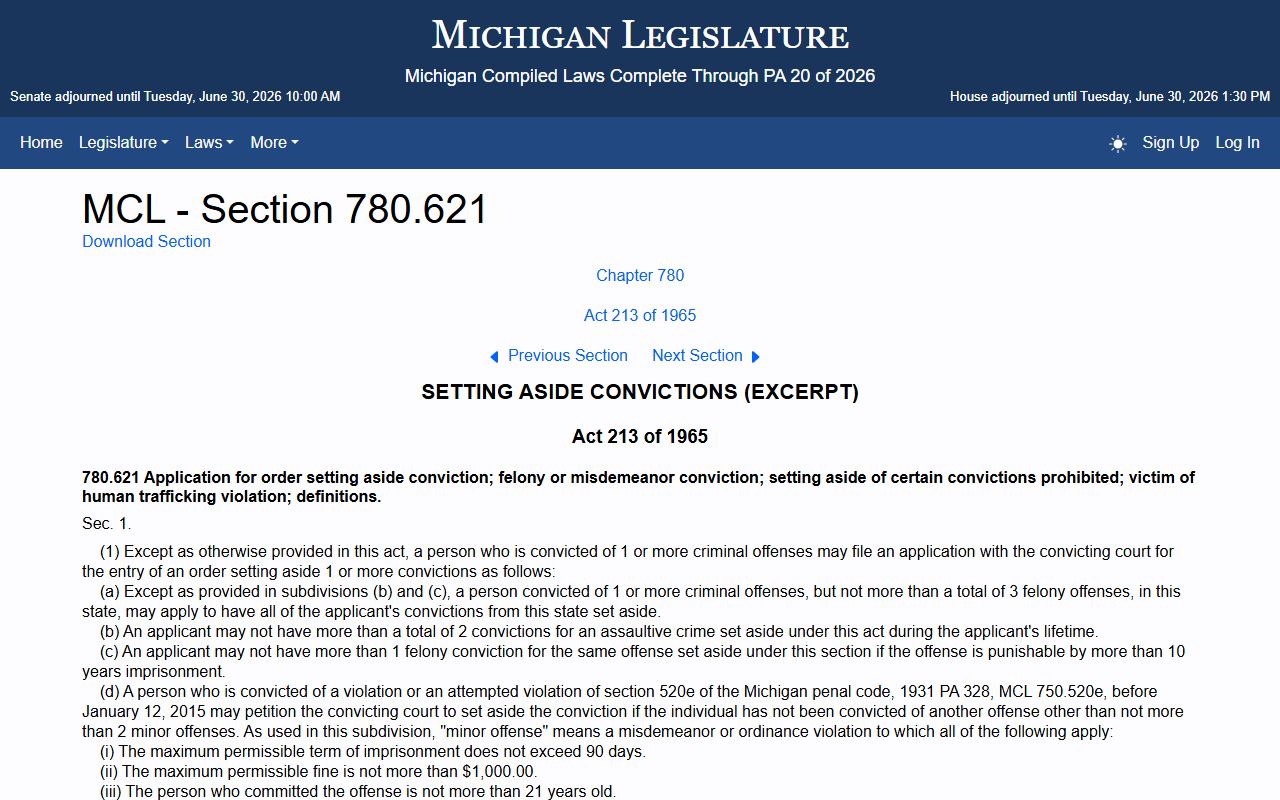
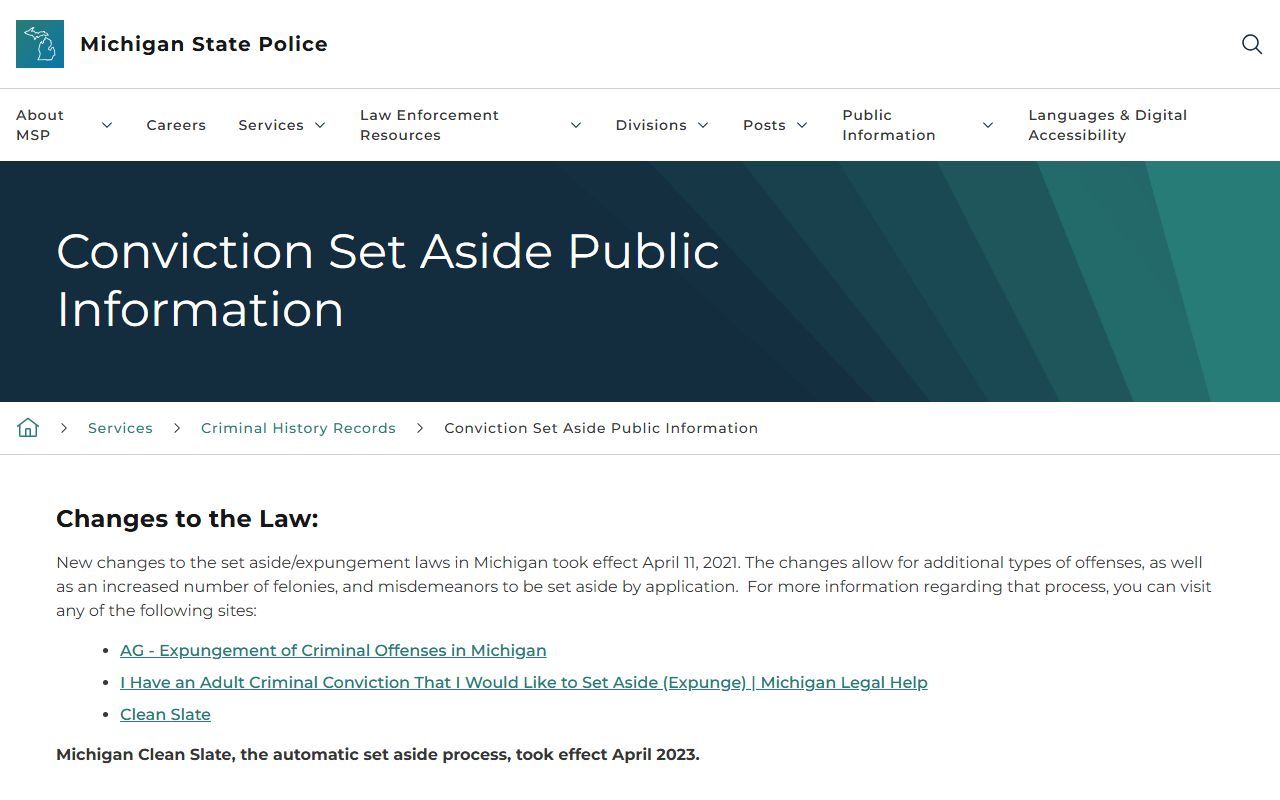
The Clean Slate reforms, effective April 11, 2021, widened eligibility and started an automatic set-aside process for some convictions. The Michigan State Police explains the public effect on its set-aside page, and applicants who file by hand use the state court form.
An applicant files in the court where the conviction happened, using a separate application for each court, on SCAO form MC 227. A traffic conviction carries a special limit. Under MCL 780.621c, setting aside a traffic conviction does not remove it from the Secretary of State driving record.
| Sealed | Set Aside / Expunged | |
|---|---|---|
| Effect | Hidden from public view | Treated as nonpublic for most purposes |
| Law Enforcement | Limited access retained | Courts and police keep access |
| How It Happens | Court order in a specific case | Application under MCL 780.621 or automatic Clean Slate |
| Form | Court-specific | SCAO form MC 227 for most set-asides |
The practical route starts with the conviction court. A 96th District Court misdemeanor is filed in that court, while a 25th Circuit Court felony is filed in Circuit Court. Pull the judgment, confirm eligibility, complete the form, and attend any hearing the court sets.
Restricted Marquette County Criminal Court Records
Not every criminal-adjacent file is open. Juvenile delinquency cases are restricted under MCL 712A.28, and access can require party status, attorney authority, or a court order. The juvenile and family division of the county courts handles delinquency, abuse and neglect, and related matters, and those files carry heavier protection than an adult case.
Other pieces are shielded inside otherwise public files. Sealed and set-aside convictions drop out of public view. Mental-health commitment proceedings in Probate Court are restricted. Protected personal identifying information, minor names, and financial account data are redacted from public registers under the court rules.
Sealed and pending files stall online searches. When a public search returns nothing, the record may be nonpublic, or it may simply not be posted. Call the clerk of the court that would hold the case to confirm which situation applies before assuming a file does not exist.